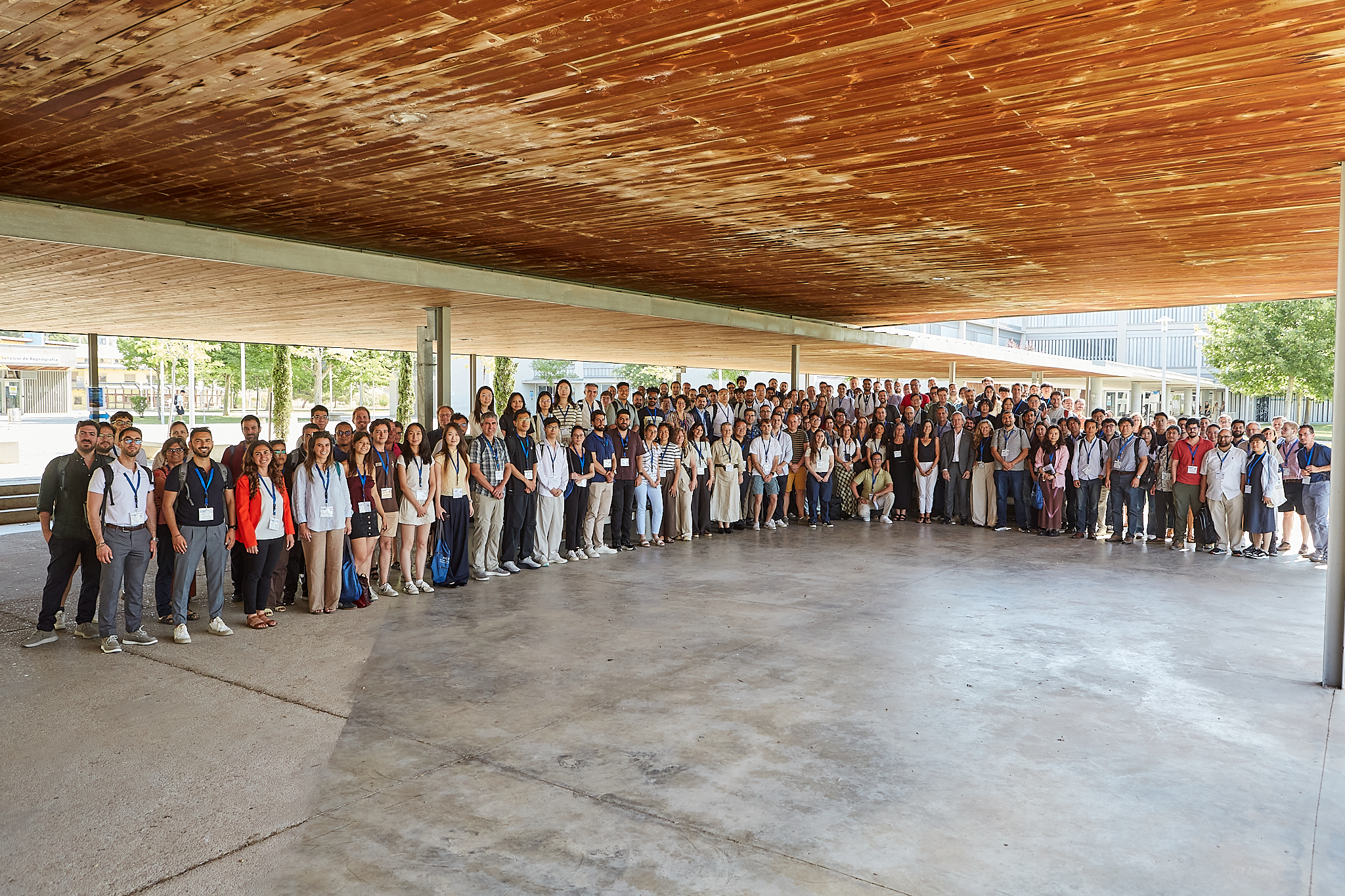
Can AI predict a flood hours or days in advance? What is a river’s digital twin? How are droughts managed using real-time data? What does the future hold for smart reservoirs? What is the link between water, energy and food? What technologies are already being used in Spain to manage water risks? These are some of the issues that will be addressed in Zaragoza this week. Until Friday 26 June, the Río Ebro Campus is hosting the 16th edition of the International Hydroinformatics Congress (HIC 2026), one of the world’s leading events on innovation and smart water management. This is the first time the event has been held in Spain, bringing together 350 specialists from 34 countries.
Organised by the Computational Hydraulics Group at the Aragón Engineering Research Institute (I3A) of the University of Zaragoza – of which Pilar García Navarro, Pilar Brufau and Mario Morales are members – the conference will examine how tools such as artificial intelligence, big data analysis, high-performance computing and so-called digital twins are transforming the way water resources, infrastructure and water-related risks are managed.
Against a backdrop of longer droughts, more frequent floods and growing pressure on water resources, researchers, engineers and managers will discuss the technologies that are already beginning to be used to anticipate extreme events and improve decision-making.
“Water management is at a turning point,” says researcher Pilar García Navarro, from the Computational Hydraulics Group and coordinator of the Local Organising Committee for this conference. The increase in droughts, floods and extreme weather events linked to climate change, together with the growing demand for water for consumption, agriculture and energy, “means we must develop smarter and more efficient tools. Hydroinformatics enables the integration of models, real-time data and artificial intelligence to support faster and better-informed decisions.”
The challenges facing hydroinformatics include the development of new sensors and tools, the analysis of large volumes of data, the use of high-performance computing and cloud technologies, the real-time management of water infrastructure, and the incorporation of sustainability criteria and social acceptance into decision-making.
Among the topics to be covered at the conference:
- Artificial intelligence applications for the early prediction of floods and droughts.
- Systems capable of managing reservoirs and water infrastructure in real time.
- Digital twins of rivers, catchments and water systems to simulate scenarios and anticipate risks.
- Use of big data and smart sensors to monitor water resources.
- Impacts of climate change and resilience strategies.
- New tools to improve the relationship between water, energy and food production.
- Technologies for water quality control and the management of river and coastal risks.
Artificial intelligence is already playing an increasingly important role in water management. It is used to improve early flood forecasting, optimise the operation of reservoirs, assist in infrastructure design and support real-time decision-making systems. It also enables the analysis of large volumes of data to create more accurate models and improve the ability to respond to extreme events. In many cases, these tools are already being adopted by public authorities and water management bodies.
This will be explained by Ibrahim Demir, a professor at Tulane University and chair of the International Committee on Hydroinformatics, who will analyse how artificial intelligence and intelligent decision-support systems are transforming water research, engineering and management. His work on early warning systems, digital twins and intelligent disaster analysis places him among the leading voices at the intersection of water and artificial intelligence.
The International Hydroinformatics Congress will also feature researchers such as Enrique Playán and Enrique Cabrera, who have extensive international experience, and who will provide context for the current challenges facing water management in Spain.
40 years of research from Zaragoza
The fact that the conference is being held in Zaragoza also serves as a recognition of the research carried out at the University of Zaragoza in this field. The Grupo de Hidráulica Computacional, part of the I3A’s Fluid Dynamics Technologies group and coordinated by researcher Pilar García Navarro, the team has been working since 1986 on the development of advanced models for the simulation of rivers, canals and floods, with real-world applications used by public and private authorities and organisations.
In recent years, their research has focused on combining high-performance computing and artificial intelligence to develop digital twins capable of supporting the management of complex water systems and improving decision-making in high-risk situations.
For this research group, the meeting represents an opportunity to discuss some of the issues that will shape the future of water management against a backdrop of growing climate uncertainty and rapid digital transformation.
Programme for the International Hydroinformatics Congress and speaker details:
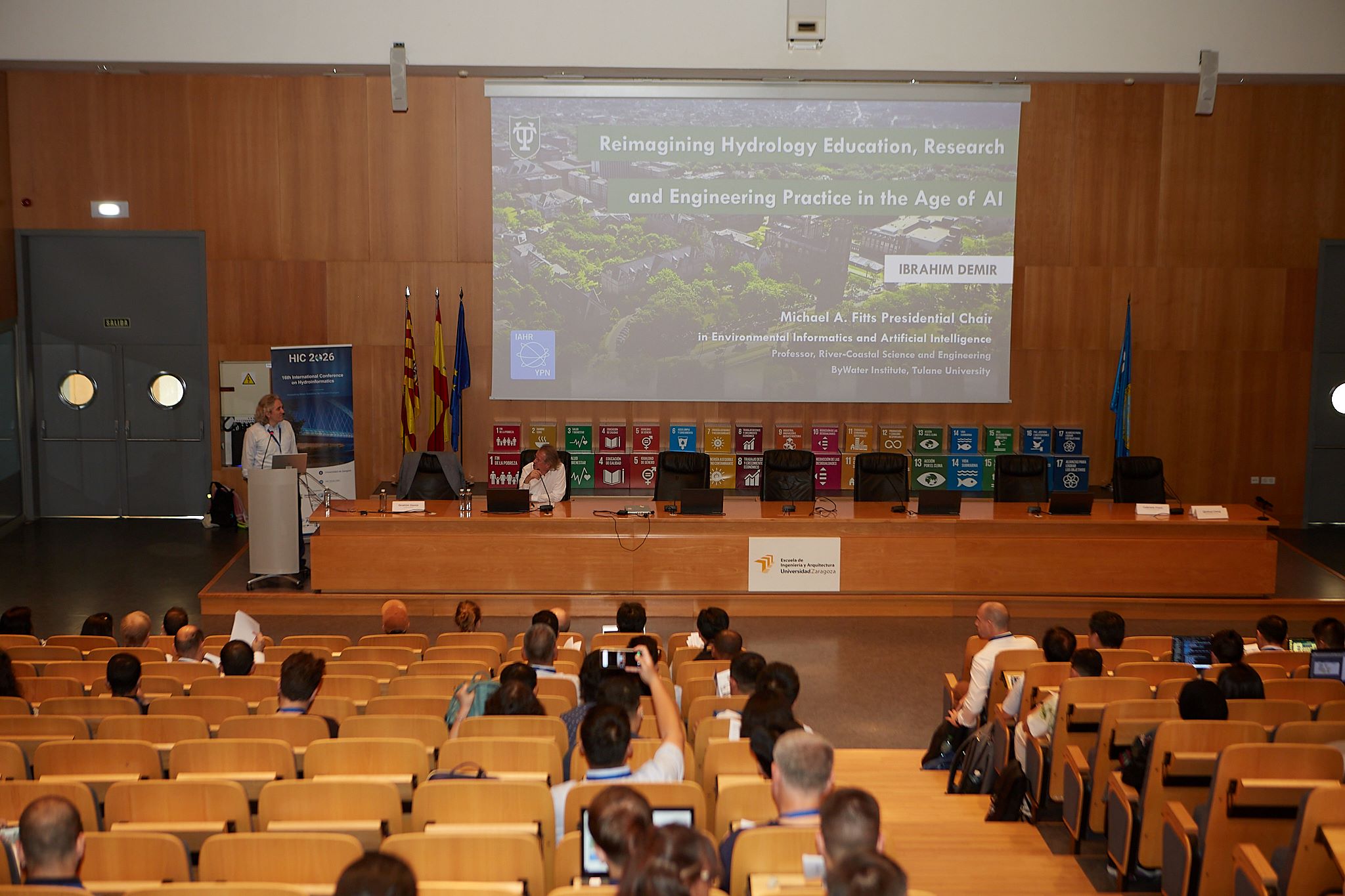
Photo credits: Simón Aranda
Caption: One of the plenary sessions of the Congress in the Betancourt Building on the Río Ebro Campus.
A welcome ceremony was held in the Paraninfo at the University of Zaragoza, attended by the Vice-Chancellor, Rosa Bolea. Also in attendance were Dolores Pascual, Director-General for Water at the Ministry for Energy Transition and Demographic Challenge, and Carlos Arrazola, President of the CHE. Joining them were Philippe Gourbesville, President of the International Association for Hydro-Environment Engineering and Research (IAHR), and Pilar García Navarro, Chair of the Organising Committee.