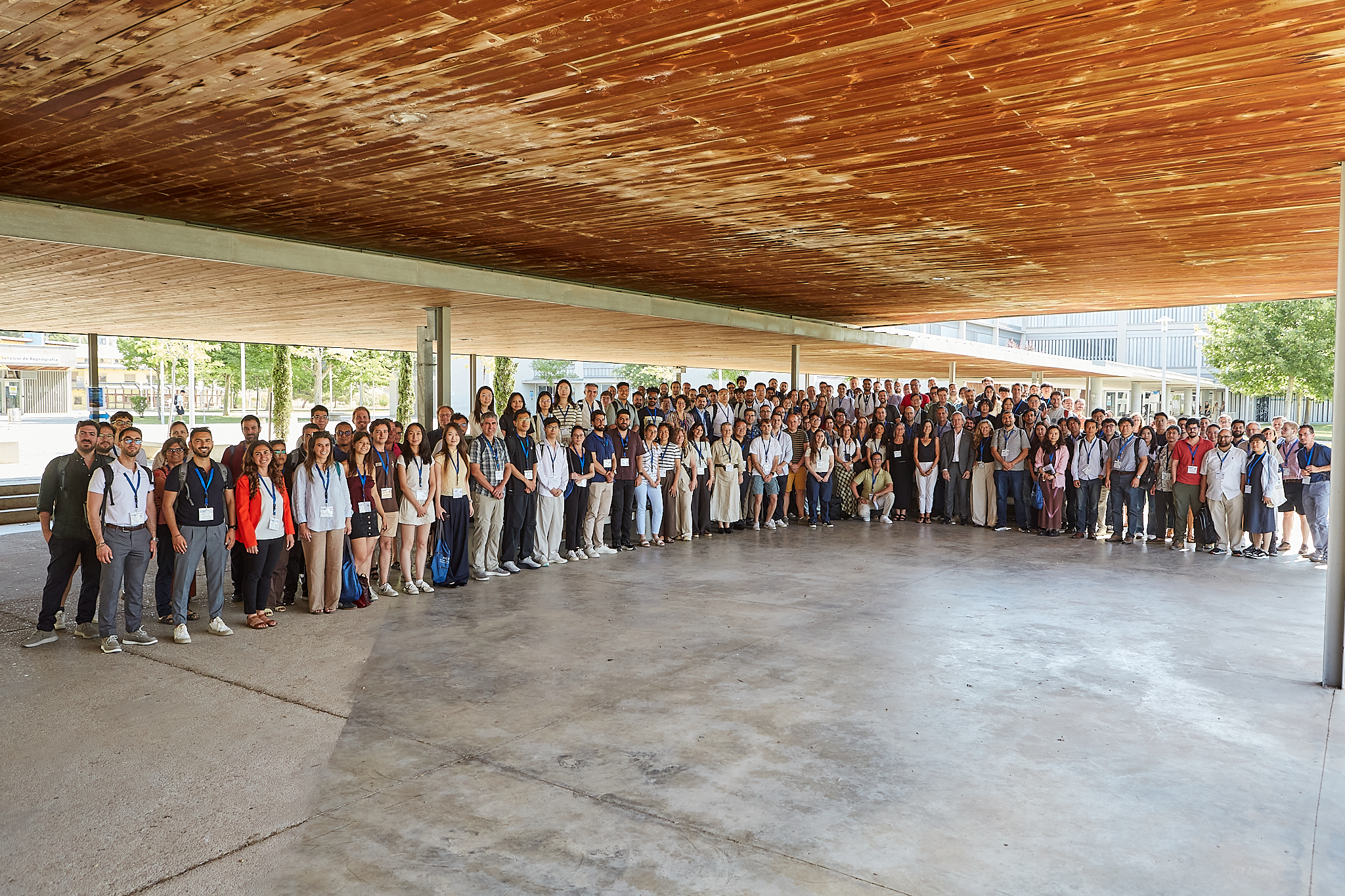
Elías Cueto, a researcher at the Aragón Institute for Engineering Research (I3A) at the University of Zaragoza, has been awarded a prestigious ERC Advanced Grant from the European Research Council (ERC), one of Europe’s most competitive and highly regarded funding schemes for cutting-edge research.
With funding of up to 2.5 million euros over a five-year period, it will enable his research group, Applied Mechanics and Bioengineering (AMB), to develop the PHYSIA (Physics-Informed Spatial Artificial Intelligence) project, within the framework of the I3A’s Chair in the National Strategy on Artificial Intelligence.
This is a pioneering initiative that aims to lay the foundations for a new generation of artificial intelligence capable of understanding the physical world by incorporating the laws of physics into its learning models.
The award of this Advanced Grant places Elías Cueto and the I3A amongst the elite of European research and represents significant international recognition of the scientific excellence achieved at the University of Zaragoza.
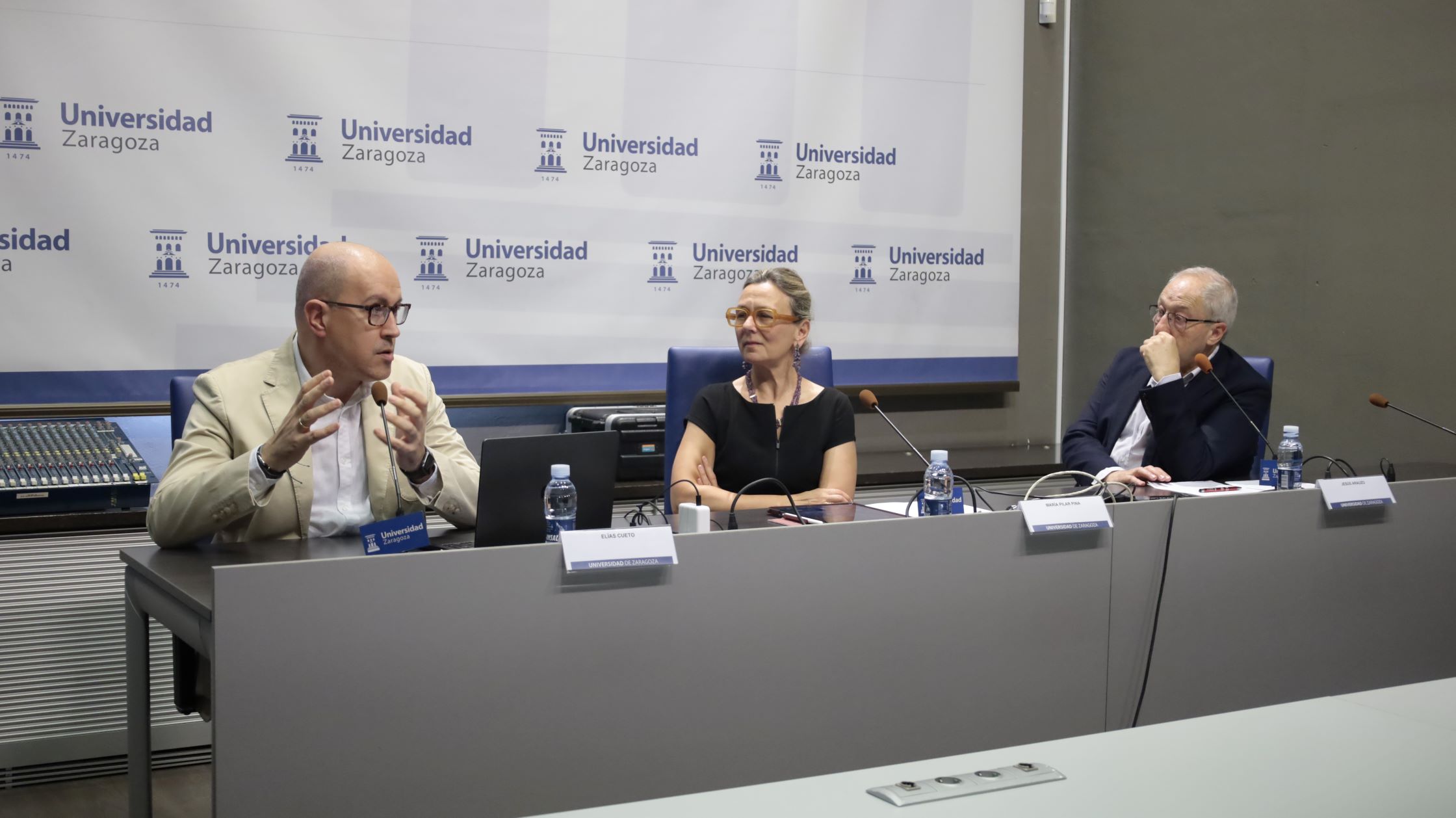
The project was presented this morning at a press conference, attended not only by the researcher but also by the Vice-Rector for Scientific Policy, Pilar Pina, and the Director of the I3A, Jesús Arauzo.
Towards artificial intelligence that understands how the world works
Although recent advances in artificial intelligence, particularly thanks to large language models, have been extraordinary, there is a growing consensus within the scientific community on the need to equip these systems with a deeper understanding of the physical environment.
The PHYSIA project is based on this premise and proposes to develop a new scientific discipline known as ‘physics-informed spatial AI’.
Its aim is to create artificial intelligence systems capable of interpreting, understanding and interacting with real three-dimensional environments, by integrating the scientific knowledge accumulated over centuries regarding the behaviour of matter, structures and physical phenomena.
To this end, it will combine artificial intelligence, computer vision, computational mechanics and digital twins. The systems developed will be capable of automatically constructing digital models of objects and scenarios from images, predicting with great accuracy how they will behave under different conditions.
New possibilities for industrial design and the industrial metaverse
One of the most innovative aspects of PHYSIA will be the development of new generative artificial intelligence models capable of designing products and processes whilst taking real-world physical constraints into account from the outset.
This approach will pave the way for entirely new design methodologies, in which artificial intelligence not only generates creative solutions but also automatically assesses their physical and functional viability.
The results of PHYSIA will open up new possibilities for the creation of physically realistic virtual worlds, giving rise to what researchers refer to as the industrial metaverse. In these environments, simulated reality will be able to interact with physical reality, making it possible to evaluate designs, processes or prototypes without the need to build them first.
Furthermore, the project will explore new forms of extended reality and simulated reality, incorporating visual components that will facilitate knowledge transfer and decision-making in engineering environments.
A multidisciplinary team and new opportunities for young researchers
In addition to Elías Cueto as principal investigator, the project will involve Iciar Alfaro, a specialist in industrial applications, and David González, who will be responsible for the theoretical aspects; both are members of the AMB (Applied Mechanics and Bioengineering) group at I3A.
The funding will enable the recruitment of new research talent through the appointment of two postdoctoral researchers and five pre-doctoral researchers, who will undertake their doctoral theses as part of the project over the coming years.
PHYSIA will thus help to strengthen the I3A’s international leadership in strategic fields such as artificial intelligence, advanced simulation, computational engineering and digital twins, as well as consolidating the University of Zaragoza’s ability to attract highly competitive funding from the Horizon Europe programme.
Unizar, in one of the most competitive selection processes in Europe
ERC Advanced Grants form part of Pillar I, ‘Excellent Science’, of the Horizon Europe programme. They are aimed at researchers with at least ten years of outstanding scientific achievements who are internationally recognised for the originality and impact of their contributions.
It is one of the most competitive calls for proposals in Europe. For the 2025 round, the available budget will fund approximately 276 projects, representing an estimated success rate of around 8 per cent.
Researcher Elías Cueto’s project is one of the 276 disruptive projects selected by the European Union that will receive €683 million in funding under the ERC Advanced Grant scheme. A total of 3,329 proposals were received for this round, representing a 31 per cent increase on the previous year.
With this new grant, the University of Zaragoza has now secured funding for 27 ERC projects since 2009, when this call for proposals began, with a total amount of €43.2 million, placing it amongst the leading Spanish universities in the national ranking by number of ERC grants obtained under the Horizon Europe programme.
The 27 ERC Excellence projects secured by the Aragonese public campus are divided into the following categories: Proof of Concept, 5; ERC-Starting, 9; ERC-Consolidator, 5; ERC-Advanced, 6; and Synergy Grant, 2 (one coordinated by Unizar and the other in which it acts as a collaborating institution).
The Vice-Rector for Scientific Policy, María Pilar Pina, has highlighted the significance of this project and congratulated I3A researcher Elías Cueto on securing it. “ERC Advanced Grants recognise researchers with exceptional scientific careers and projects capable of transforming their field of knowledge. The fact that the University of Zaragoza has now secured 27 grants from the European Research Council demonstrates that our scientific talent competes and excels at the highest international level, and reinforces our commitment to excellent research that has an impact on society,” said the Vice-Rector for Scientific Policy, María Pilar Pina. “The award of this ERC Advanced Grant demonstrates that the University of Zaragoza is not only participating in the technological revolution currently taking place in Aragón, but is also helping to lead it through knowledge. PHYSIA places our university at the international forefront of artificial intelligence and advanced simulation, precisely at a time when Aragón is positioning itself as a European leader in digital technologies and smart industry.”
International standing: ERCs at Unizar’s I3A
Since 2023, the I3A has secured 8 ERC projects: three Starting Grants (StG), one Consolidator Grant (CoG), one Advanced Grant and three Proof of Concept (PoC) grants, thereby establishing itself as a leading institution in talent retention, the competitive acquisition of European funding and international standing. These results reinforce the institute’s standing within the European ecosystem of research excellence and demonstrate its ability to attract and support high-potential researchers.
ERC at the I3A over the last 3 years:
- Jaime Ibáñez (ECHOES)
- Alejandra Consejo (VisionSAFE)
- Ana Serrano (PROXIE)
- Héctor Sarnago (SPEED)
- Elías Cueto (PHYSIA)
In addition, two Proofs of Concept (PoC) linked to José Manuel García Aznar’s ICOMICS project – VASTO and HYMATE – have been secured, as well as one from Jaime Ibáñez’s ECHOES project.