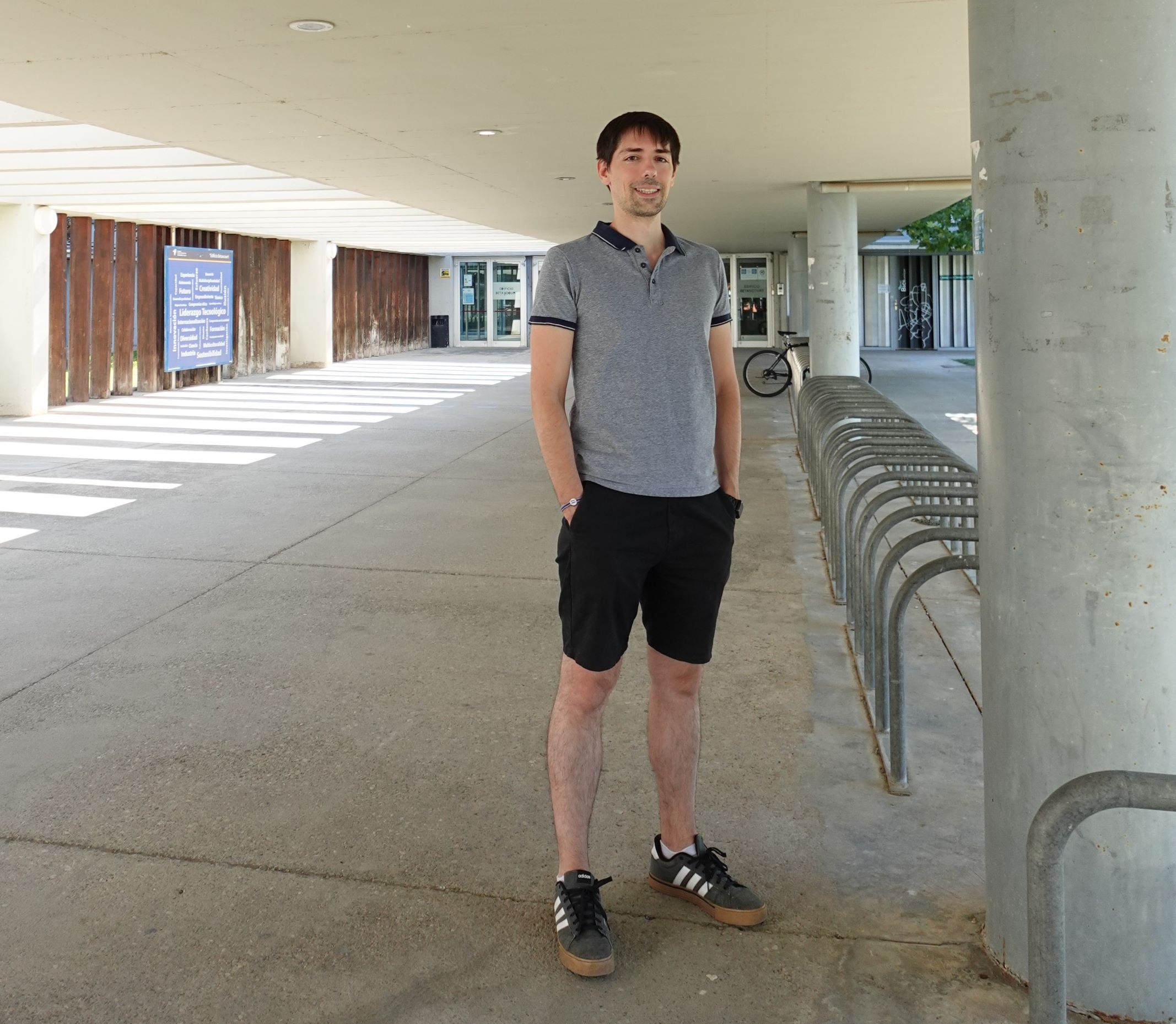
Researcher Manuel Bailera, who works in the Energy and CO2 (ECO2) group at I3A Unizar, is one of three young researchers from the University of Zaragoza to have been awarded one of the BBVA Foundation’s Leonardo Grants for Scientific Research and Cultural Creation, each worth 50,000 euros, which will enable them to carry out highly innovative projects over an 18-month period in the fields of biology, engineering and chemistry.
Although they belong to very different disciplines, the three projects share a common aim: to transform scientific knowledge into solutions to some of the major challenges facing our society.
Through the DEIAT project, Manuel Bailera aims to decarbonise the steel industry, which is responsible for 9 per cent of global CO₂ emissions. A pilot plant, the only one of its kind in the world, is to be built at the University of Zaragoza with the aim of resolving a critical question: is it possible to burn a renewable solid fuel (biochar) in the nozzles of a blast furnace in the presence of H₂ and CO without these gases competing for the available oxygen? The success of this study will lay the foundations for the development of technologies to produce environmentally friendly steel.
Given that the steel industry is responsible for 7–9 per cent of global CO₂ emissions and that the traditional “blast furnace–basic oxygen furnace” (BF-BOF) process will remain predominant due to the limited availability of scrap, “there is an urgent need to develop technologies that reduce the use of coke and coal through the use of alternative reducing gases. However, there are serious uncertainties as to whether these injected gases, particularly hydrogen, might react prematurely with the oxygen intended for the combustion of pulverised coal, thereby compromising the furnace’s efficiency,” explains Manuel Bailera.
To address this issue, the DEIAT project proposes to adapt an experimental entrained-flow reactor facility at the University of Zaragoza, which is already designed to replicate the extreme conditions found in the nozzles (1800–2200 °C and 5 bar pressure). The project involves assessing the risks of explosion and H₂ leaks, redesigning critical components such as the preheater and the injector, and carrying out a series of 32 experimental tests using coal and biochar to compare their conversion in H₂/CO-rich atmospheres with that in conventional atmospheres. This will result in the world’s only facility capable of validating these conditions, consolidating the research group’s leadership and meeting the technological needs of industry.
Manuel Bailera holds a PhD in Renewable Energy and Energy Efficiency and is a Ramón y Cajal researcher at the I3A at the University of Zaragoza. He was awarded an Individual Marie Curie Fellowship, and his outstanding scientific career focuses on the decarbonisation of industry through the use of renewable energy. He has spent time in five different countries over a period of more than two years and is leading a research project to carry out the first experiments on decarbonisation technologies in blast furnaces.
He is a member of the Energy and CO2 (ECO2) research group, whose areas of research focus on the use of renewable energy and thermochemical energy storage systems, and on improving the processes of CO2 reduction, capture, transport, storage and utilisation in those applications where renewable energy generation is not currently feasible.
In 2024, he received the Third Millennium Award as a ‘Young Research Talent’ and the ‘Blanca Catalán de Ocón’ Aragón Investiga Award for young researchers. He has been included for two consecutive years (2024 and 2025) in Stanford University’s prestigious ‘World’s Top 2% Scientific List’. His doctoral thesis won three awards: in Environmental Engineering (MLN Chair), in CO₂ capture technologies (PTECO2), and the Extraordinary Doctoral Award (Unizar).
Red Leonardo: a community of 800 researchers and creators
Alongside Manuel Bailera at the University of Zaragoza, the following have been selected: Beatriz Herguedas, a biochemist at the Institute of Biocomputation and Physics of Complex Systems (BIFI-Unizar); and Alberto Concellón, a chemist at the Aragon Institute of Nanoscience and Materials (INMA), a joint centre of the Spanish National Research Council (CSIC) and the University of Zaragoza (Unizar).
In total, 59 unique projects have been selected for this edition from a total of 1,896 applications, reflecting a highly competitive call for proposals with a success rate of 3.1 per cent. These are individual projects, developed by professionals in 11 fields of science, technology and culture who are at a decisive stage in their careers: researchers and creators with an average age of 38.5 years, possessing extensive international experience, some of whom come from world-leading centres and institutions.
The 2026 Leonardo Scholarships have been allocated across 12 autonomous communities: 21 scholarships in Catalonia; 16 in the Community of Madrid; 6 in Andalusia; 3 in Aragon, the Valencian Community and the Basque Country; 2 in Castile and León; and 1 in the Canary Islands, Cantabria, Castile-La Mancha, Extremadura and Galicia.
For more than two decades, the BBVA Foundation’s work has focused on supporting excellence in science and culture, as well as promoting their impact on society. Established in 2014, the Leonardo Scholarships represent a strategic and distinctive initiative by the Foundation to achieve this objective, by fostering knowledge understood as a continuum of research and creation. For this reason, the programme was named after Leonardo da Vinci, as its essence lies in championing knowledge, whether it be scientific or creative inquiry.
The scholarship holders for this 13th edition are joining the Leonardo Network, a community now comprising 800 researchers and creators, alongside the experts who have served on the programme’s assessment panels since its inception.
Further information on the Leonardo Scholarships: https://www.redleonardo.es/informacion-bases-becas-red-leonardo/