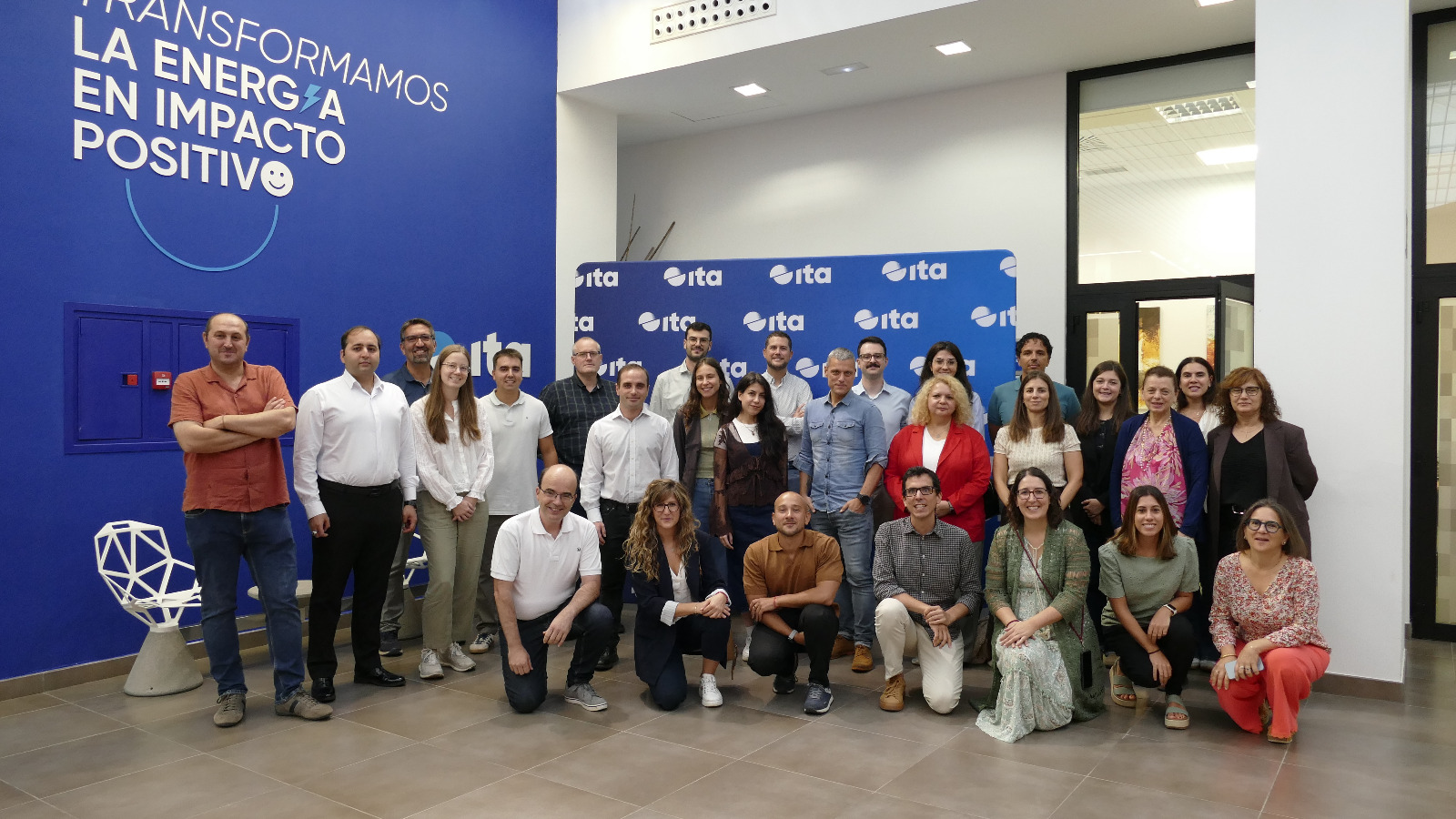
Over the next four years, the European UNCOVER project will work to demonstrate that industrial emissions can be converted into a raw material, thereby gradually reducing dependence on fossil resources and promoting more circular production models.
The initiative, funded by the European Commission with €7 million through the Horizon Europe programme, and with a total budget of €8.6 million, has been launched today in Zaragoza and will run for four years. The project is coordinated by the Aragón Technology Institute (ITA), with the University of Valladolid acting as technical coordinator, and involves researchers from the Aragón Engineering Research Institute (I3A) at the University of Zaragoza.
UNCOVER will bring together 19 partners from eight European countries to tackle one of the main challenges facing industrial decarbonisation: moving CO₂ utilisation technologies from the development and demonstration phase to scalable, sustainable and economically viable solutions. This was highlighted on 30 September at the partners’ meeting held at the ITA headquarters in Zaragoza to officially launch the project.
From captured CO₂ to products for industrial use
UNCOVER will showcase six innovative CO₂ conversion technologies (CCT) and one secondary conversion technology (SCT), which will enable the production of ten products for different markets.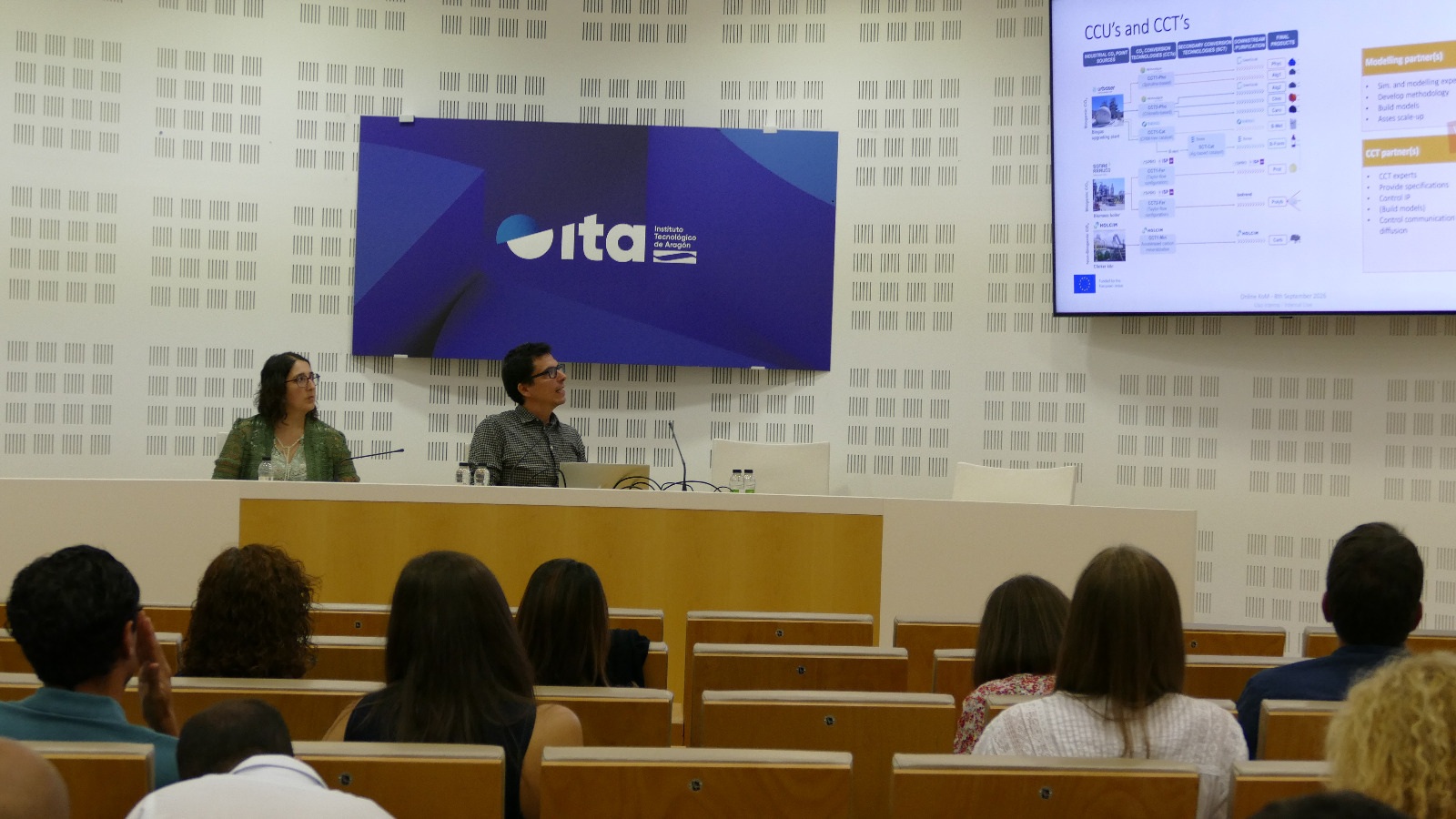
These include pigments, microalgae biomass, biomethanol, bioformaldehyde, microbial protein, polyhydroxybutyrate and carbonate-based cementitious materials. These products will be tested for use in sectors such as the chemical, fuel and construction industries, with the aim of assessing their potential to replace fossil-based alternatives or those that are resource-intensive.
One of the key distinguishing features of UNCOVER will be the use of real industrial emission sources. The technologies will be tested using CO₂ from three activities representative of European industry: a biogas recovery unit at a waste management facility in Zaragoza; a biomass boiler at a timber manufacturing plant in Valladolid; and a clinker kiln at a cement plant in Poland.
In this way, the project will enable the behaviour of the technologies to be analysed under conditions similar to those of their future industrial application.
“Transforming gases such as CO₂ or bio-based raw materials into high value-added products is one of the most promising ways to consolidate the circular economy,” says Salvador Izquierdo, a researcher with the Fluid Dynamics Technology group at I3A Unizar.
However, there are still barriers to overcome in order to speed up their market launch. Their involvement in the UNCOVER project will focus on developing working methodologies “designed to manage this uncertainty and mitigate risks”, explains the I3A researcher. To this end, they will integrate experimental data, numerical simulation and all the technical knowledge accumulated on the behaviour of the reactors and processes under study. In this context, the UNCOVER initiative enables the future behaviour of these technologies to be accurately predicted.
Assess sustainability and economic viability
UNCOVER will carry out an integrated life-cycle assessment (LCA) and a techno-economic analysis (TEA) to examine aspects such as environmental impact, energy consumption, production costs and the potential for scaling up.
This approach will provide evidence regarding the conditions necessary for CO₂ utilisation technologies to progress towards commercial deployment.
“UNCOVER aims to demonstrate that CO₂ can be used as a raw material to produce biodegradable plastics, resins for wood-based panels, low-carbon fuels and cement-based materials, competing with fossil-based alternatives in terms of cost, performance and sustainability,” explains Pablo González, UNCOVER coordinator at the ITA.
“By demonstrating seven CCU pathways at industrial scale using three real-world sources of industrial emissions, we are building the knowledge base that European industry needs to expand the use of CO₂ and accelerate industrial decarbonisation,” he adds.
A strategy focused on industrial roll-out
UNCOVER’s ambition extends beyond the project’s four-year duration. The initiative sets out a roadmap to facilitate the market entry of these technologies and their subsequent large-scale deployment.
Among its objectives is to contribute, by 2032, to the large-scale deployment of three CO₂ conversion technologies and to ensure that between three and five CO₂-based products begin to replace fossil raw materials and those that are resource-intensive.
In the longer term, the project estimates that by 2040, 31 conversion technologies developed under the UNCOVER project could be deployed, with a potential capture of around 0.1 million tonnes of CO₂ and the creation of approximately 150 new jobs.
Looking ahead to 2050, a wider roll-out of these technologies could contribute to the capture of up to 250 million tonnes of CO₂ in Europe, according to the project’s estimates.
A European consortium to cover the entire innovation chain
The UNCOVER consortium comprises six major industrial companies, five SMEs, three research and technology organisations, four universities and an industry association.
This structure brings together complementary capabilities in research, technological development and industry to cover the entire innovation chain, from conversion technologies to product validation and their potential market launch.
The partners include Urbaser, Sonae Arauco España, Holcim Polska, Allmicroalgae Natural Products, Viscofan España and Ercros, as well as Energo, Syspro Automation, Biotrend, Chimar and Steinbeis Innovation.
The consortium is rounded off by Associação Oceano Verde, the Holcim Innovation Centre, I3A – University of Zaragoza, Imperial College London, the Silesian University of Technology and CO₂ Value Europe.
Through its participation in UNCOVER, I3A continues its research into reducing CO₂ emissions and turning this into an opportunity to develop new raw materials, products and industrial models.
About UNCOVER
UNCOVER is funded by the European Union under the Horizon Europe programme, grant agreement number 101269441. The project will run for four years and began in September 2026.