Reducing ammonia (NH₃) emissions has become an environmental and strategic priority for the future of the agricultural and livestock sector. These emissions, which are largely linked to the management of manure, slurry and nitrogen fertilisers, have a direct impact on air quality and contribute to the acidification and eutrophication of ecosystems. Furthermore, their role in the formation of particulate matter poses a growing challenge to public health and to the achievement of environmental targets set at national and European level.
Against this socio-economic and environmental backdrop, the Vice-Chancellor’s Office building on the Teruel Campus hosted a conference yesterday entitled “The challenge of ammonia emissions: monitoring, control and utilisation in the agricultural and livestock sector”. The event, organised by the Aragon Institute of Engineering Research (I3A) and the Teruel Polytechnic University School, brought together specialists from the scientific, technical and institutional fields to promote the exchange of knowledge and debate on viable and sustainable solutions. It also provided an opportunity to learn about advances in emission reduction technologies, new management tools and practical experiences in the sector, promoting collaboration among all stakeholders and helping to drive more efficient, innovative and environmentally friendly agricultural and livestock production.
In this regard, Salvador Izquierdo, a researcher and deputy director of the I3A, explained that this “is a serious and urgent environmental problem that requires immediate attention”. He also pointed out that the problem is that little is known about it and “we all have a great deal to learn”.
The director of the I3A, Jesús Arauzo, highlighted the importance of bringing together the various stakeholders working to find solutions to the problem of ammonia emissions, which he described as “critical”, and pointed out the need for legislation, “regulations on emissions and how to measure them”.
Hence the importance of this meeting, “to find out how to mitigate, control and remedy ammonia emissions from the agricultural and livestock sector”, noted Jesús Arauzo.
Cutting-edge research and ongoing projects
During the technical workshop, five key projects currently being developed in Aragón were presented:
- Manurefinery Project: Focused on the development of a process for cleaning and recovering ammonia emissions, led by Salvador Izquierdo (TFD-I3A group).
- Ecopornicus Operational Group: Dedicated to monitoring NH3 emissions into the atmosphere using data from the European Copernicus programme, also led by Salvador Izquierdo (TFD-I3A group).
- Knowledge Generation Project: focused on the characterisation of materials for NH3 adsorption from agricultural waste, explained by Gloria Gea (GPT-I3A group).
- LIFE Projects: aimed at monitoring NH3 emissions into the atmosphere from livestock facilities, slurry pits and croplands, presented by Adelaida Perea, from the Aragon Centre for Agri-Food Research and Technology (CITA).
- ECOAIR Project: focusing on air quality in agricultural environments, led by Miguel Escudero, from the Institute of Biocomputation and Physics of Complex Systems (BIFI).
Innovación, sostenibilidad y competitividad
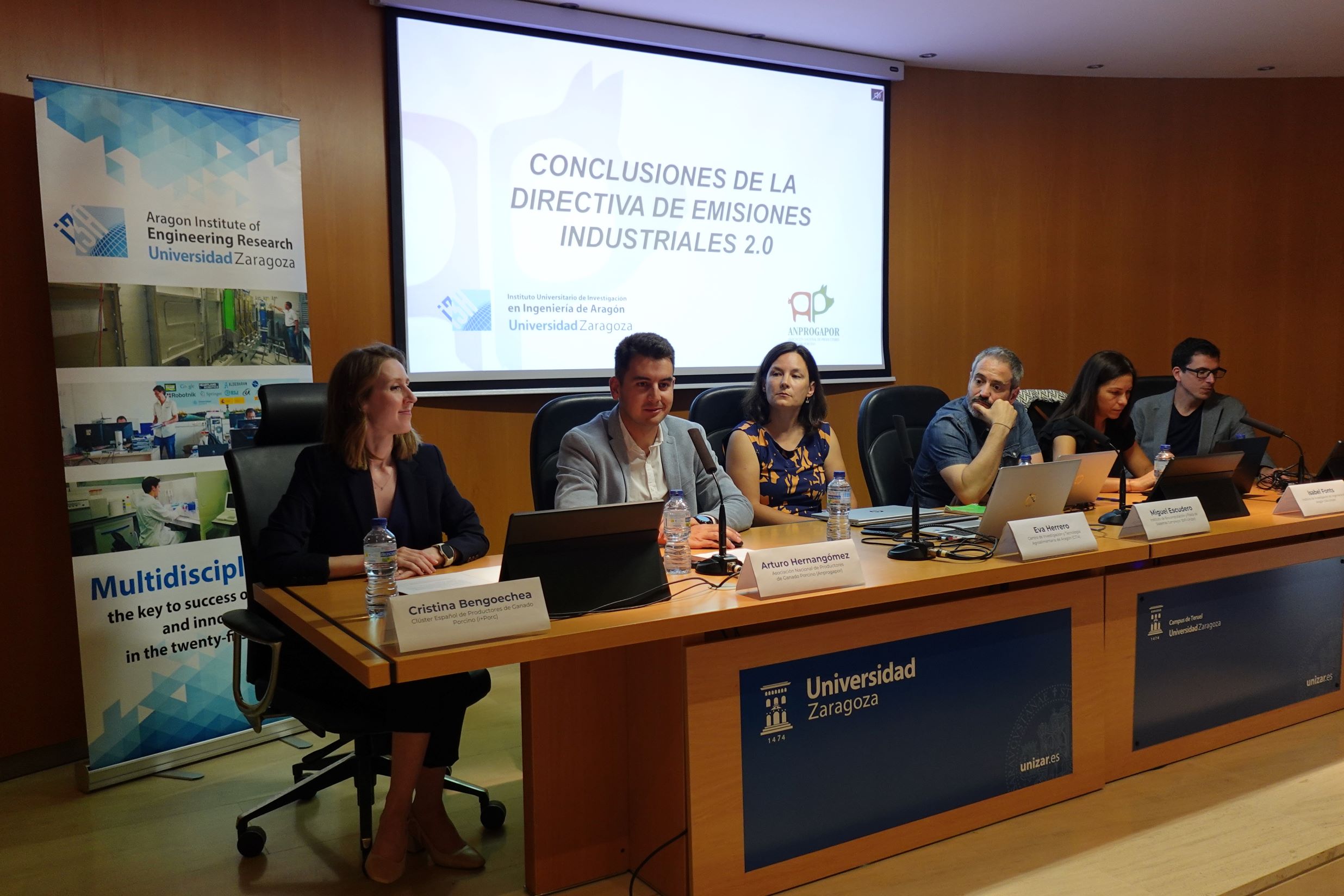
A round-table discussion highlighted the work being carried out across various fields of work and research to facilitate new avenues of collaboration between the stakeholders involved.
- Cristina Bengoechea, representative of the Spanish Pig Producers’ Cluster (i+Porc), chaired this session, which featured the following participants:
- Arturo Hernangómez (National Association of Pig Producers – Anprogapor) provided an update on the best available techniques for mitigating NH3 emissions on farms.
- Eva Herrero (CITA) explained the key aspects of monitoring NH3 emissions at sites, in storage facilities and in the field.
- Miguel Escudero (BIFI-Unizar) analysed the current challenges in assessing the impact of NH3 emissions on air quality.
- Isabel Fonts (I3A-Unizar) discussed the recovery of ammonia and energy through gasification processes, as well as the design of adsorbent materials for capturing this compound.
- Salvador Izquierdo (I3A-Unizar) presented the latest advances in the design of specific equipment for the recovery of air streams containing NH3.
By hosting this forum in the province of Teruel, the I3A and its partner organisations aim to bring scientific knowledge directly to the region, promoting innovative technologies that ensure the sustainability and competitiveness of a sector that is strategic for the Aragonese economy.