Researcher Esther Pueyo, from the BSICoS group (Biomedical Signal Interpretation and Computational Simulation) at the Aragón Institute of Engineering Research (I3A), is participating in a new European Marie Skłodowska-Curie Doctoral Network (MSCA DN), one of the European Union’s most competitive calls for proposals for the training of pre-doctoral researchers.
The project (The Cardiovascular Digital Twin Network, CDT-net) will develop digital twin technologies for use in cardiovascular medicine, with the aim of moving towards a more preventive and personalised approach to cardiology. Cardiovascular diseases are currently one of the leading causes of death and healthcare expenditure in Europe, accounting for around 1.9 million deaths annually and associated costs of €169 billion.
The initiative combines computational models and artificial intelligence to create virtual representations of patients, thereby improving the early identification of risks, enhancing diagnostic accuracy and optimising clinical decision-making.
The Cardiovascular Digital Twins Network will address the scientific, technological, ethical and regulatory challenges associated with the adoption of these technologies by training highly specialised pre-doctoral researchers. The network promotes collaboration between medicine, engineering, computer science and the social sciences, as well as between the academic, clinical, industrial and regulatory sectors, with the aim of accelerating the implementation of personalised cardiovascular medicine.
The BSICoS group plans to recruit two pre-doctoral researchers and supervise a third, and has been awarded funding of €564,376.32. The consortium is coordinated by King’s College London and brings together 10 international partners and 9 associated organisations.
Una investigadora con cinco redes doctorales
The European Commission (EC) has selected the project in which Esther Pueyo is participating, alongside Ana Mincholé, a researcher from the same group at the University of Zaragoza. The project will be carried out by international consortia under the Marie Sklodowska-Curie Actions (MSCA) – Doctoral Networks DN 2025, part of the Horizon Europe programme.
With this new project, Esther Pueyo has now secured five Marie Skłodowska-Curie doctoral networks with the BSICoS research group. This is an exceptionally outstanding and rare achievement at institutional level, highlighting the high standards of excellence, competitiveness and international impact of this I3A Unizar group in the field of cardiovascular research and European doctoral training.
In particular, it is worth noting that, with the three Doctoral Networks secured over the last four calls, the group has secured a total of €1,098,535.68, in addition to its participation in two further MSCA ITN networks under Horizon 2020, further consolidating its track record and standing in highly competitive European programmes.
The MSCA Doctoral Networks 2025 call has funded 141 projects out of 1,602 proposals submitted, with a success rate of around 9%, which highlights the high standards of this European programme for research excellence.
Otros proyectos MSCA Doctoral Networks
In addition to this latest project by the Cardiovascular Digital Twins Network, Esther Pueyo has managed two other “Doctoral Networks” projects over the past four years:
- TrackAF (Translational Research and Training on Atrial Cardiomyopathy as a Key to Better Atrial Fibrillation Management) - Translational research and training in atrial cardiomyopathy as the key to better management of atrial fibrillation.
Its aim is to improve the understanding, diagnosis and treatment of atrial fibrillation and atrial cardiomyopathy. It combines mechanistic computer simulations, data-driven modelling, clinical artificial intelligence and experimental research. It focuses on individual risk prediction, patient stratification and the improvement of short- and long-term treatment outcomes.
- INSIDE-HEART (multI-discipliNary, multi-Sectoral and multi-national trainIng network on Digital biomarkErs for supraventricular arrHythmia charactErizAtion and Risk assessment).
It proposes the development of innovative technologies to monitor the risks associated with atrial fibrillation, particularly outside the clinical setting, and to facilitate early intervention where necessary. With the funding secured, PhD students are being trained in the development of mathematical and computational tools to predict adverse events in patients with atrial fibrillation and to propose effective, preventive and personalised treatment methods.
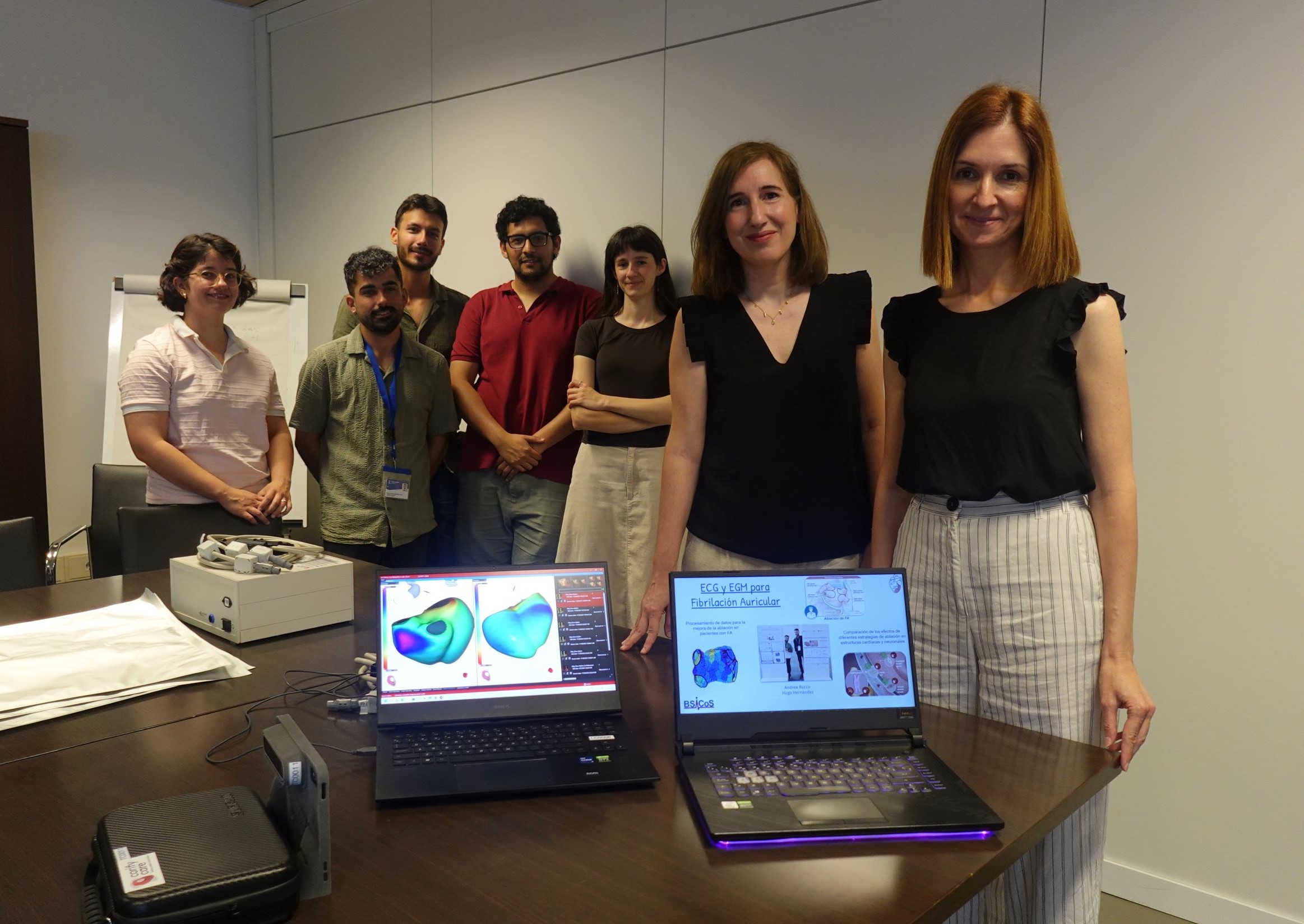
Caption: Esther Pueyo and Ana Mincholé, alongside young researchers from the BSICoS group.